
Propane Furnace, Natural Gas or Heat Pump? Options for Rural Livingston County Homes
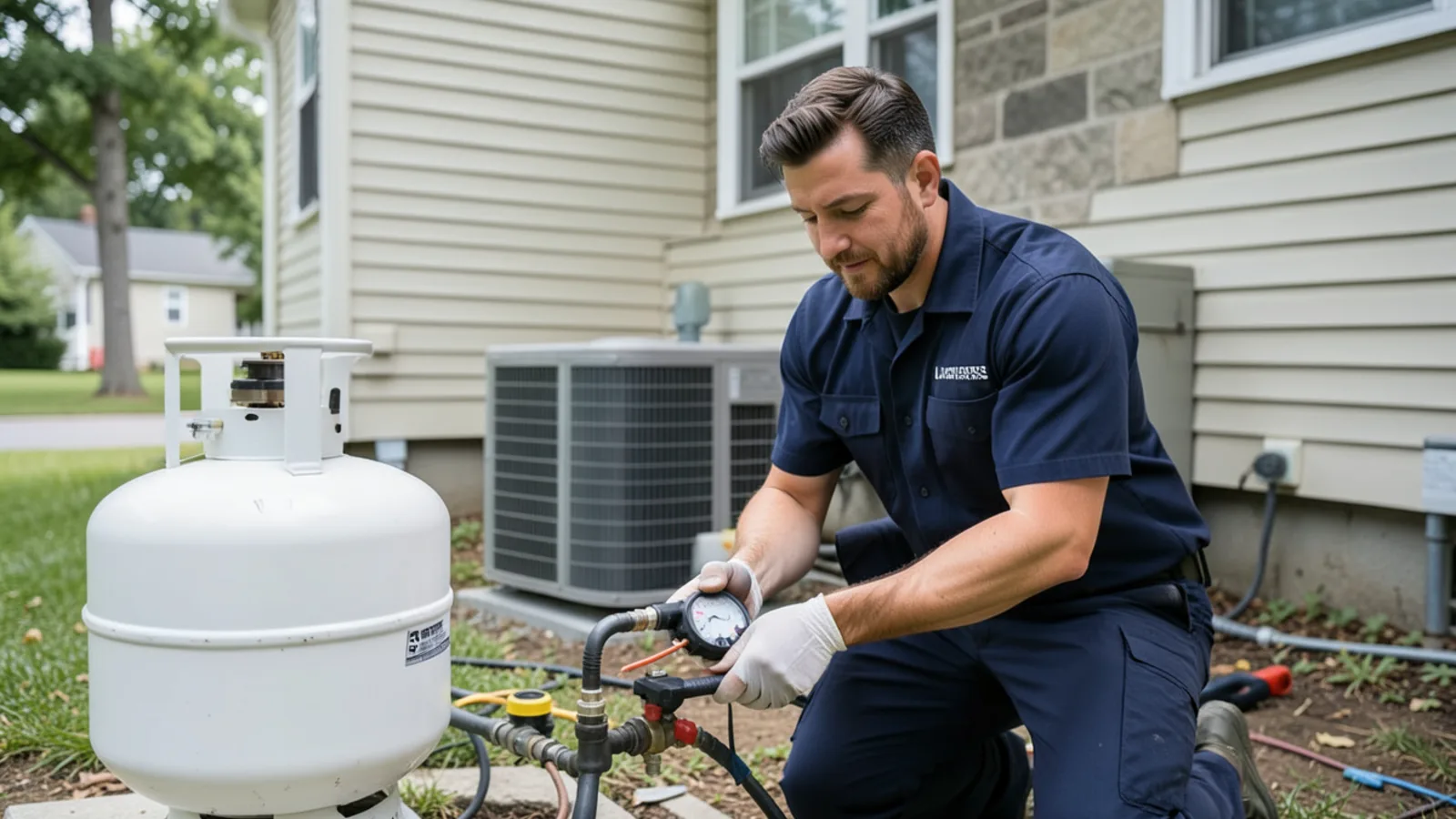
For rural Livingston County homes without municipal natural gas, a hybrid dual-fuel heat pump system offers the lowest annual operating cost—slashing heating bills by 40% to 55% compared to delivered LP propane alone. An electric inverter heat pump heats efficiently down to 25°F–30°F, while your propane furnace engages automatically for sub-zero Michigan polar snaps. Call PerformanceMech at (321) 666-8870 to calculate your home's exact balance point.
The True Cost of Heating with Delivered LP Propane in Southeast Michigan
Across unincorporated Livingston County—including the wooded parcels of Hartland, the rolling acreage of Oceola and Howell Townships, and the lake-adjacent lots of Hamburg and Pinckney—thousands of homeowners live outside municipal natural gas utility service boundaries. For decades, the default heating solution has been a standalone liquid propane (LP) furnace fueled by an outdoor 500-gallon or 1,000-gallon storage tank. However, heating a home purely with delivered propane exposes families to severe financial vulnerability.
Seasonal Price Spikes and Delivery Surcharges
Unlike regulated natural gas utilities where rates are overseen by the Michigan Public Service Commission, delivered propane is an unregulated bulk commodity. Prices routinely swing from $1.90 per gallon during summer fill-up promotions to $3.25 or even $3.80 per gallon during prolonged January polar vortex events when regional wholesale supply chains tighten. For a 2,400-square-foot rural home consuming 250 to 350 gallons of propane during a freezing month, a single monthly fuel fill can easily top $800 to $1,100.
The Physical Heat Content Disadvantage of Propane
From a thermodynamic standpoint, one gallon of liquid propane yields approximately 91,500 British Thermal Units (BTUs) of gross heat energy. In contrast, one therm of natural gas provides 100,000 BTUs, while electricity delivers 3,412 BTUs per kilowatt-hour (kWh). When burning propane in a standard 80% to 92% Annual Fuel Utilization Efficiency (AFUE) furnace, you are paying roughly $28 to $35 per million BTUs (MMBtu) of delivered thermal heat. Heating with modern high-efficiency electric heat pumps drops that delivered cost down to $14 to $19 per MMBtu across the majority of the heating season.
Tank Maintenance, Lease Fees, and Winter Access Hazards
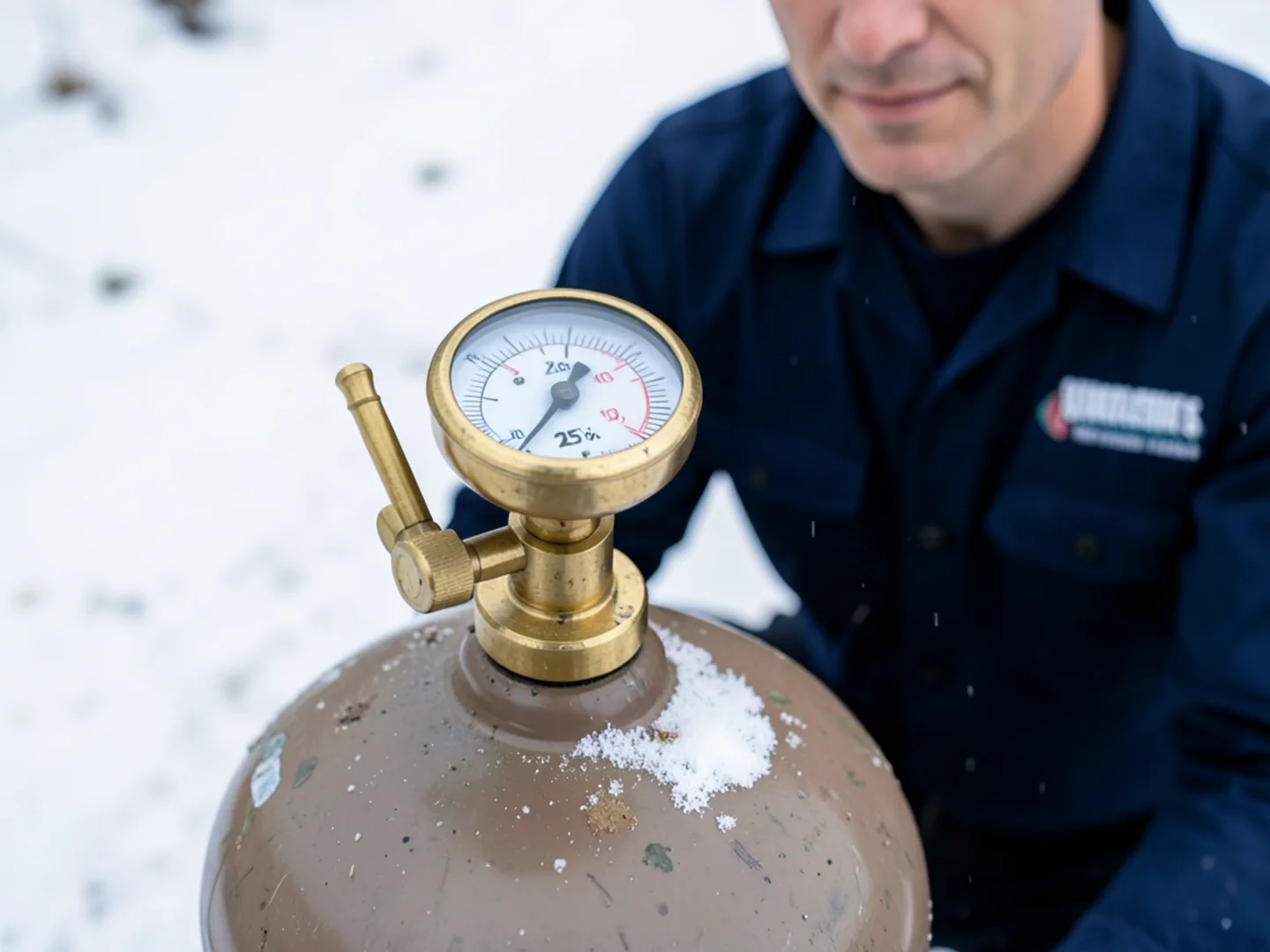
Beyond fuel consumption costs, propane systems require active logistics. Rural homeowners face annual tank lease fees, mandatory pressure tests after running dry, and the constant stress of monitoring floating tank gauges during blizzards. When rural gravel driveways freeze over in Livingston County, heavy 10-wheel bulk fuel delivery trucks can struggle with access, risking emergency fuel runouts when temperatures are at their absolute lowest.
Need an Expert On Site at Your Home?
Our Brighton HVAC team provides prompt dispatch across Livingston County. Call (321) 666-8870.
Cold-Climate Heat Pumps: Inverter Physics Down to Sub-Zero Cold
Homeowners who recall the legacy heat pumps of the 1980s and 1990s often remember drafty, lukewarm air that struggled whenever outdoor temperatures dipped below 40°F. Modern cold-climate heat pumps represent an entirely different technological generation driven by variable-speed inverter compressors and advanced refrigerant chemistry.
Variable-Capacity Inverter Compressor Technology
Traditional single-stage compressors operate strictly in binary mode: 100% full capacity or 0% off. In contrast, modern inverter-driven rotary compressors modulate their operating speed smoothly between 20% and 115% in response to minute temperature changes. By accelerating compressor rotational speeds at low outdoor temperatures, the system compresses vaporized refrigerant to higher pressures and temperatures, maintaining strong heating capacity even when outdoor ambient air is below freezing.
Enhanced Vapor Injection (EVI) Down to -15°F
Premium cold-climate heat pumps incorporate Enhanced Vapor Injection (EVI) flash-tank cycles. By injecting an intermediate-pressure subcooled refrigerant stream directly into the compressor scroll, the system prevents compressor overheating while extracting atmospheric heat down to -15°F (-26°C). These units deliver warm 105°F to 115°F supply air across duct registers, completely eliminating the chilly drafts associated with legacy heat pump equipment.
Coefficient of Performance (COP) and Thermodynamic Leverage
Electric resistance heating has a COP of 1.0, generating exactly one unit of heat per unit of electrical energy consumed. A cold-climate heat pump does not create heat through resistance; it absorbs and pumps existing ambient thermal energy from outdoor air. At 45°F, an inverter heat pump operates at a COP of 3.8 to 4.2 (380% to 420% efficiency). Even at 17°F, high-efficiency models maintain a COP above 2.4. Every hour your home heats via a heat pump rather than burning delivered propane represents immediate, compound energy savings.
Hybrid Dual-Fuel Architecture: How Propane and Heat Pumps Work Together
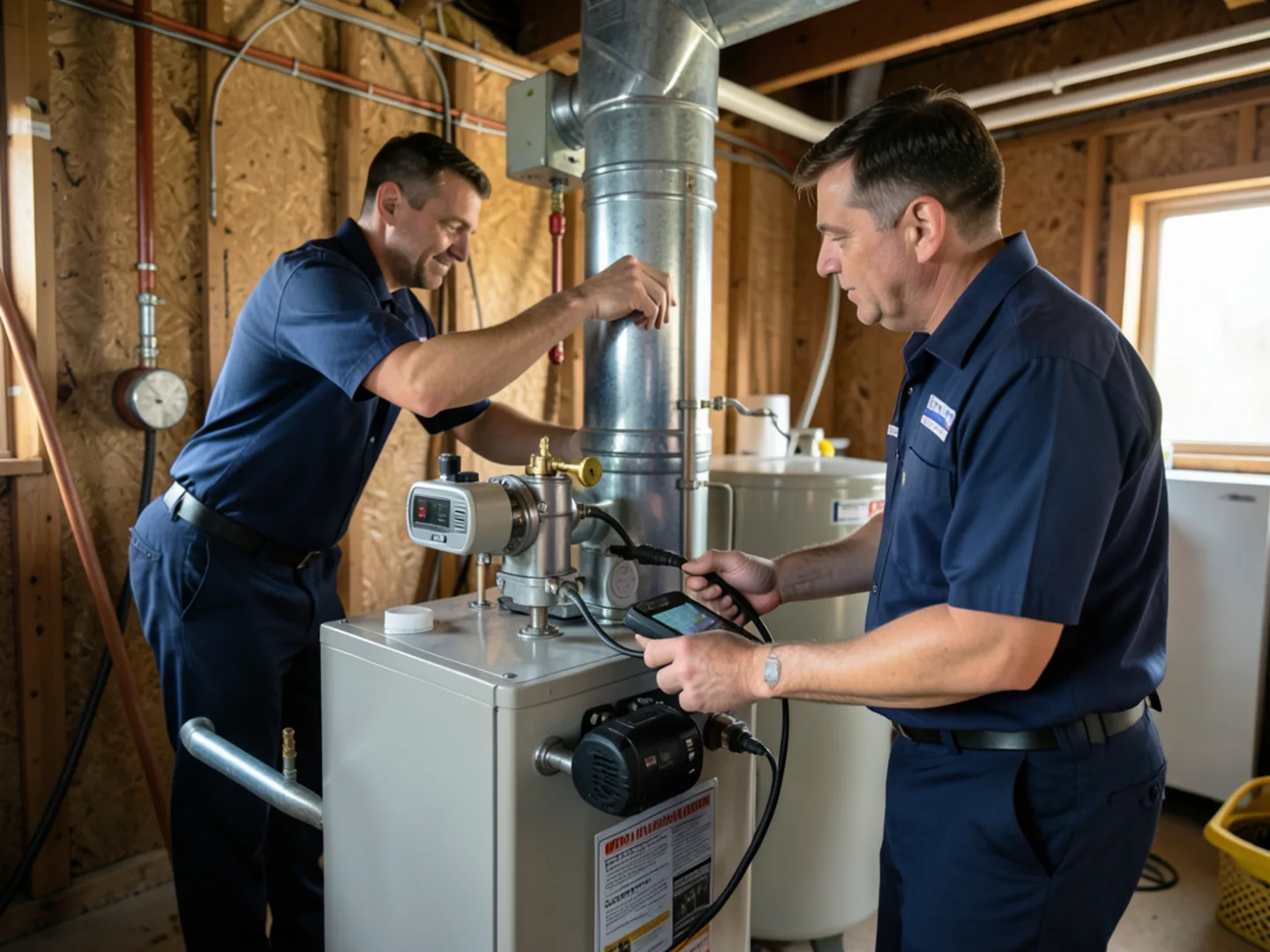
For rural Michigan homes, the ultimate heating and cooling strategy is not an all-or-nothing choice between propane and electricity. The premier engineered solution is a hybrid dual-fuel system: pairing an outdoor cold-climate heat pump with an indoor high-efficiency propane furnace.
How Dual-Fuel Mechanical Integration Operates
In a dual-fuel installation, the outdoor heat pump replaces your conventional central air conditioner, sitting on an elevated mounting pad outside the foundation. Indoors, an evaporator coil is cased directly above your high-efficiency propane furnace. Throughout late spring, summer, and early autumn, the system functions as an ultra-high-efficiency central air conditioner (SEER2 ratings from 16 to 20+). When autumn arrives, the system operates in reverse, using the heat pump to warm the home efficiently without igniting the propane burners.
The Intelligent Smart Thermostat Brain
A communicating smart thermostat wired to an outdoor weather sensor or local internet meteorological data continuously monitors ambient temperatures. When outdoor conditions remain mild to moderate (above the designated balance point), the heat pump quietly satisfies home heating demands. When outdoor temperatures plunge below the balance threshold, the thermostat seamlessly shifts operation to the propane furnace. The furnace fires its burners, generating intense 130°F plenum heat to easily combat sub-zero winter gales.
Redundancy and Total Winter Peace of Mind
Dual-fuel heating provides invaluable mechanical redundancy for rural homeowners. If a propane delivery delay occurs during an ice storm, the heat pump can maintain comfortable indoor temperatures down into the teens. Conversely, if an extended winter power outage strikes and you operate an emergency portable generator, powering a gas/propane furnace requires merely 600 to 800 watts for the blower motor, whereas running a heavy electric resistance heat pack would overload standard residential generators.
Economic Balance Points: Finding the Exact Switching Temperature
A dual-fuel system is only as effective as the calibration of its thermal and economic balance points. Understanding the mathematical difference between where a heat pump loses thermal capacity versus where propane becomes cheaper to burn is the hallmark of professional HVAC engineering.
Thermal Balance Point vs. Economic Balance Point
The thermal balance point is the outdoor temperature where a home's structural heat loss exactly equals the maximum heating output of the heat pump. Below this temperature, supplemental heat is physically required. The economic balance point, however, is purely financial: it is the exact outdoor temperature where the cost per delivered MMBtu of heat pump electricity equals the cost per delivered MMBtu of propane. In Southeast Michigan, because delivered propane is expensive, the economic balance point is frequently lower than the thermal balance point (typically between 22°F and 30°F).
Mathematical Formula for Livingston County Energy Rates
To calculate the economic balance point, PerformanceMech engineers compare the current cost of delivered propane against off-peak and standard electric rates from DTE Energy or Consumers Energy. When propane sells for $2.80 per gallon in a 95% AFUE furnace, delivered heat costs $32.22 per MMBtu. With electric rates at $0.19 per kWh, a heat pump operating at a COP of 2.0 produces heat for $27.84 per MMBtu. At that pricing, running the heat pump remains financially superior all the way down to approximately 20°F.
Seasonal Energy Capture Hours
According to historical National Weather Service meteorological data for Livingston County, temperatures between 25°F and 55°F account for roughly 62% of the total annual heating hours between October and April. By handling this entire temperature band with electric heat pump COP leverage, homeowners conserve 500 to 900 gallons of delivered LP propane every single winter.
Fuel Comparison Matrix: Propane vs Heat Pump vs Dual-Fuel
To assist Livingston County acreage homeowners in evaluating upfront equipment investments against ongoing winter fuel overhead, PerformanceMech has compiled real-world operating comparisons based on a typical 2,500-square-foot residential home in Hartland or Howell.
| System Configuration | Typical Upfront Investment | Average Winter Operating Cost | Sub-Zero Heating Delivery | Livingston County Ideal Application |
|---|---|---|---|---|
| Standard 80%-90% Propane Furnace Only | $4,200 – $6,500 | $2,400 – $3,600 / season (at $2.60–$3.20/gal LP) | Intense 125°F–135°F register heat regardless of outdoor temp | Properties with small electric panels (100A) or low winter occupancy |
| All-Electric Cold-Climate Heat Pump with Electric Strips | $9,500 – $14,500 | $1,800 – $2,500 / season (at $0.18–$0.21/kWh DTE) | 100°F–110°F register air; expensive 15–20 kW strip heat below -5°F | Homes seeking complete fossil-fuel elimination with 200A+ electric service |
| Hybrid Dual-Fuel (Inverter Heat Pump + Propane Furnace) | $8,800 – $13,500 | $1,350 – $1,950 / season (hybrid fuel optimization) | Seamless dual-source: heat pump down to 28°F, propane below 28°F | Recommended for Hartland, Howell, & Pinckney acreage parcels with existing LP tanks |
Acreage Installation Requirements: Electrical Service, Tank Siting, and Snow Clearance
Upgrading a rural property to a hybrid dual-fuel or cold-climate heat pump configuration involves specific mechanical and electrical site preparations tailored to Michigan winter conditions.
Electrical Service Panel Capacity (100A vs. 200A)
Unlike an all-electric system that requires a massive 50- to 70-amp breaker for emergency electric resistance heat strips, a dual-fuel heat pump relies on your propane furnace for auxiliary heat. As a result, the outdoor heat pump typically requires only a standard 30- to 40-amp 240V dedicated double-pole breaker. Most rural homes with existing 100-amp or 200-amp electrical panels can accommodate a dual-fuel heat pump without an expensive utility service upgrade.
Snow Riser Elevation and Drift Management
In Livingston County, winter snowfalls frequently accumulate drifts of 12 to 18 inches along foundation perimeters. Mounting an outdoor heat pump flat on a ground-level concrete slab will result in drifting snow choking the outdoor coil, triggering frequent defrost cycles and ice encasement. PerformanceMech installs all rural heat pumps on heavy-gauge powder-coated structural steel snow riser stands, elevating the equipment 12 to 18 inches above finished grade to ensure clear airflow and proper defrost drainage.
Refrigerant Line Set Lengths and Underground Runs
Rural homes with detached walkout layouts or expansive landscaping may require longer line set distances between the outdoor condenser and indoor evaporator coil. Professional installation requires precise calculation of additional oil and R-410A/R-454B refrigerant charges, proper copper line insulation with UV-resistant jacketing, and nitrogen purging during brazing to protect sensitive inverter expansion valves.
Field Notes on Setting Economic Balance Points in Livingston County
The most critical configuration step on rural acreage is programming the dual-fuel changeover thermostat with real local energy economics rather than leaving it on the factory default 40°F setting. Modern inverter heat pumps maintain a Coefficient of Performance (COP) well above 2.2 even down at 20°F. If delivered propane is running at $2.85 per gallon and DTE electric rates are 19 cents per kilowatt-hour, your thermodynamic breakeven is actually 26°F. By calibrating the outdoor lock-out sensor to 25°F–28°F, you capture an extra 450 hours of ultra-efficient electric heating every November and March, keeping hundreds of gallons of propane in your tank.
Frequently Asked Questions
Common questions Michigan homeowners ask our technicians regarding this topic.
Yes. Modern cold-climate heat pumps engineered with variable-speed inverter compressors and enhanced vapor injection produce reliable heat down to -15°F. However, in rural Livingston County, pairing that heat pump with an existing or new propane furnace in a hybrid dual-fuel system provides the ultimate backup: the heat pump handles mild to freezing days at 300% efficiency, and the propane furnace takes over effortlessly during intense sub-zero polar vortex events.
PerformanceMech Technical Team
Licensed Michigan Mechanical & Hydronic Specialists serving Livingston, Oakland & Washtenaw Counties.
Related Professional Services
Related Service Areas Covered
Have Heating or Cooling Trouble Today?
Call PerformanceMech Heating & Air at (321) 666-8870. Live phone response and rapid dispatch from our Brighton hub.